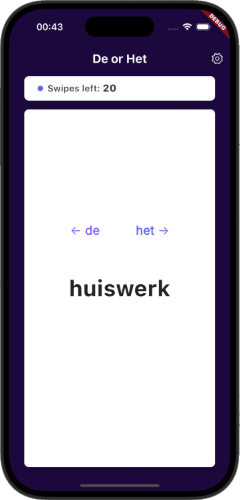
[Day 1] Started crafting my first Flutter app
I had an idea to help myself learn Dutch. But where or even how to start? Since I’m a software developer the solution was simple – let’s build an application.
The initial MVP of my first mobile app took me a couple of evenings and numerous cups of coffee. I chose Flutter which gave me the flexibility to build an app for both platforms and have full control over what happens on the screen.
So, let’s dive in and get closer to a fully functional mobile app.
The idea
Learning Dutch isn’t that easy and it’s not just about learning words to expand your vocabulary. It’s also about following the rules of grammar. But sometimes some rules are not obvious or don’t come naturally if you weren’t born in the Netherlands. So, for me as an expat those rules have to be learned by heart. I mean, there are definitely strict rules for when to use “De” or “Het” articles, but for some words you just have to memorize them.
The solution
I won’t dive into the rules too much but it is worth mentioning that there are two types of articles in Dutch, just like in English: definite and indefinite. However, in Dutch, the definite article consists of two options: “De” or “Het”.
So, as I already mentioned, for some words you have to memorize which article should be used. The regular way to memorize the word is to read it multiple times and repeat the process the next day and so on. But what if we could use another method? What about leveraging spatial memory?
For some people it can be easier to remember something if they can recall where it happened. Imagine you have all the Dutch words with the “De” article on the left side of the screen and “Het” on the right.
Swiping the card to the correct side might give you a better ability to memorize the combination. As you can see it’s not the usual memorization of words with articles. The app leverages spatial memory, meaning you swipe the card with the word in the correct direction.